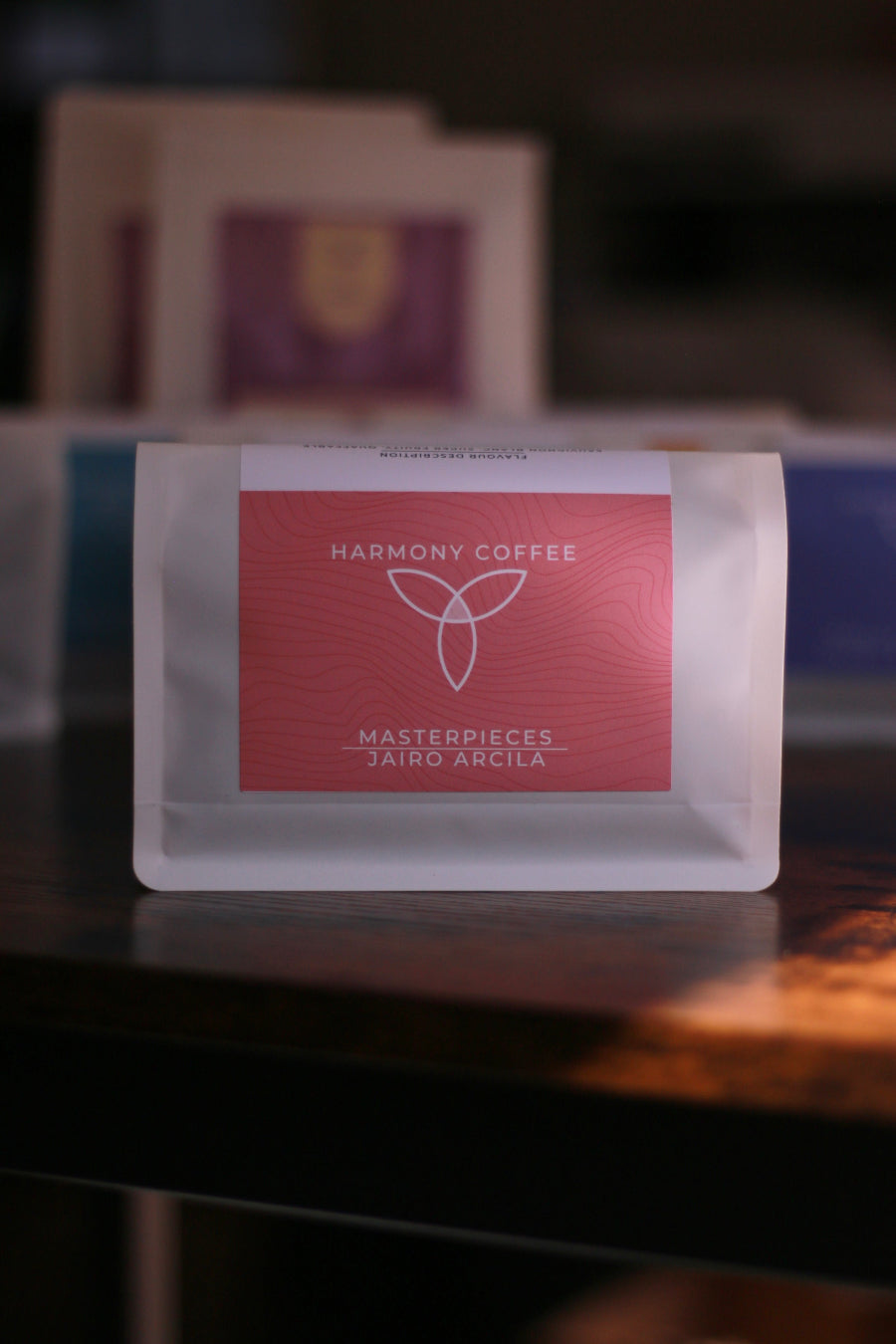
Harmony Coffee Roaster
JAIRO ARCILA JAVA
Couldn't load pickup availability
Jairo Arcila – Colombia Natural Java
An exceptionally expressive natural Java from Jairo Arcila, delivering a complex, flavourful cup of Pineapple Juice, Sauvignon Blanc and Banana Brûlée.
Flavour Characteristics
Best As: Filter Coffee / Black espresso drinks
Flavour Description: Pineapple Juice, Sauvignon Blanc, Banana Brûlée
Origin & Producer Details
- Producer: Jairo Arcila
- Farm: Santa
- Origin: Colombia
- Region: Armenia, Quindío
- Variety: Java
- Process: Natural
- Q-Score: 90.25
Suitable For & Recommended Rest
Suitable for: Espresso & filter brew methods
Recommended rest: For the best tasting results, we recommend brewing this particular coffee 24–40 days off roast. You can read more about resting coffee here.
About This Coffee
The Producer: Jairo Arcila
Jairo Arcila, a third-generation coffee grower from Quindío, Colombia, began his journey in 1987 with Finca La Esmeralda and his first Caturra lot. Balancing a full-time role as a mill manager with his passion for coffee, he honed his craft for over 40 years until retiring in 2019. His dedication led to the expansion of his holdings by five additional farms and created essential job opportunities during the harvest season.
Family and Coffee Legacy
Working alongside his wife, Luz Helena Salazar, and their two sons, Carlos and Felipe—who are now co-founders of Cofinet and specialists in specialty coffee—Jairo has elevated his coffee production to new heights. With guidance from his sons, he has refined the picking, sorting, and processing techniques across his farms, now producing exotic varieties like Chiroso, Pink Bourbon, Java, Papayo, and Gesha. Beyond coffee, Jairo's farms yield an array of other crops, and his day starts with a hearty breakfast complemented by his own exceptional brew, all while cherishing time with his family.
Farming and Community Impact
Beyond coffee, Jairo’s farms are rich with other crops, including mandarin, orange, plantain, and banana, all of which contribute to the economic vitality of his community. His dedication to quality and sustainability is matched by his commitment to providing jobs during the harvest season, directly impacting the lives of those around him.
Daily Life and Philosophy
Grounded in tradition yet always looking forward, Jairo balances his passion for coffee with a deep love for family, starting each day with a nourishing breakfast and the company of his loved ones.
About the Java Variety
Java is one of my all time favourite coffee varieties, and probably one of the coffee varieties that has the strangest cultivation journey of any variety that I've seen. Originally, Java delineates from an old Ethiopian Landrace called Abyssinia (most likely most closely related to the Typica family). From Ethiopia it was taken to Java (big shock) by the Dutch and mass cultivated in the early 19th century.
The Journey of Java Coffee
At some point during the 20th century, Java was brought to Cameroon by the Vilmorin company, where Pierre Bouharmont observed its notable resistance to CBD (Coffee Berry Disease). As such, a process of mass selection began, propagating the variety for almost 20 years. From there, it was introduced to Costa Rica, later spreading to many countries in South America, and eventually back to Ethiopia, completing a 200 year long game of ring around the Rosie. How fun!
This coffee is a great example of how processing influences flavour — you can learn more in our coffee processing guide.
How to Brew This Coffee
Because this coffee is expressive and fruit-forward, accurate dose and yield help you hit the sweet spot. We strongly recommend using a reliable scale — see our guide, The Best Coffee Scales, and our bench favourite, the Felicita Parallel.
Brewing Tips
- Rest window: Follow the recommended 24–40 days off roast for best clarity, flavour intensity and balance.
- Filter brewing: Start with a 1:16–1:17 ratio and a medium-fine grind, adjusting to balance florals and fruit intensity.
- Espresso: We have enjoyed this coffee best at between 1:2 - 1:2.2, brewed in about 30 seconds, where we achieve lots of jam-like characteristics and a syrupy body.
- Best recipe: Orea v4, 16g coffee, 250g water, 2:30 brew time. I'm using a higher dose than usual on this coffee because it gives up its soluble material very easily, so we can get heaps of body out of this brew.
Explore More Recipes
To try out more recipes from world-class coffee brewers, we've compiled this blog, featuring the best filter coffee recipes of 2026 from some of the world's best filter coffee brewers.
Explore Other Coffees
- Hatuhei - Gorgeous East Timor washed coffee with white grape, red apple and milk chocolate notes. Perfect for espresso and filter brewing.
- El Vergel Decaf - Quite possibly the best decaf coffee we've ever found. It's called 'Really good decaf' for a reason. World class flavour, without the buzz.
- Kibaya — Rwanda washed Red Bourbon. A very high-clarity washed lot with citrusy and black tea characteristics.
- El Diamante - Elegant Peruvian coffee with Silver Needle tea, red berries, and maple sweetness. High altitude growth delivers clarity, structure, and refined acidity.
- Consuelo Rubio Sidra - A high clarity anaerobic washed Sidra coffee from Peru. Herbaceous and exceptionally interesting!
- Las Brisas Pink Bourbon - An exceptionally expressive Pink Bourbon from Brayan Smith, this Colombian lot delivers a vibrant and complex cup of red berries, jasmine florals, citrus and white tea. Best enjoyed as filter, it offers outstanding clarity, sweetness and a refined, fruit-forward profile.
- Musaza Lot 3 - A bright and fruit-forward Rwanda natural Red Bourbon from Rwamatamu, offering layered citrus and stone fruit complexity. Tangerine, apricot and grapefruit notes are complemented by honeyed sweetness and a clean black tea finish, making it versatile for both filter and espresso.
- Browse our single-origin coffees
Check Out More of Our Collections
Espresso coffee beans collection
Filter coffee beans collection
Check Out Some of Our Guides
A complete beginner's guide to coffee processing methods
FAQs
What does natural processed Java coffee taste like?
Natural processed Java coffee is typically fruit-forward and expressive. In this coffee, you can expect vibrant notes of pineapple juice, wine-like acidity similar to Sauvignon Blanc, and a sweet, rounded finish reminiscent of banana brûlée.
What is the Java coffee variety?
Java is a rare coffee variety originally derived from Ethiopian landrace genetics. It is known for its disease resistance, clean structure and complex flavour profile, often combining clarity with vibrant fruit expression.
Is this coffee better for espresso or filter?
This coffee works exceptionally well for both. As a filter coffee, it highlights clarity, fruit complexity and acidity. As espresso, it becomes richer and more syrupy, with jam-like fruit characteristics and deeper sweetness.
How long should I rest this coffee before brewing?
We recommend resting this coffee for 24–40 days after roasting. This allows the flavours to fully develop, resulting in better clarity, balance and overall cup quality.
What makes natural processed coffee different?
Natural processed coffee is dried inside the whole cherry, allowing extended contact between the fruit and the seed. This typically results in more intense fruit flavours, heavier body and a more fermentation-forward profile compared to washed coffees.
Who is Jairo Arcila?
Jairo Arcila is a highly respected coffee producer from Quindío, Colombia, with over 40 years of experience. Working alongside his family, he produces high-quality specialty coffees, including rare varieties like Java, Gesha and Pink Bourbon.
What does a Q-score of 90.25 mean?
A Q-score above 90 indicates exceptional specialty coffee quality. Coffees at this level are considered outstanding, with high complexity, clarity and balance.
Why does this coffee taste like wine or fruit?
The fruit-forward and wine-like characteristics come from the natural processing method. During drying, the coffee seed remains in contact with the fruit, allowing sugars and compounds to influence the final flavour profile.