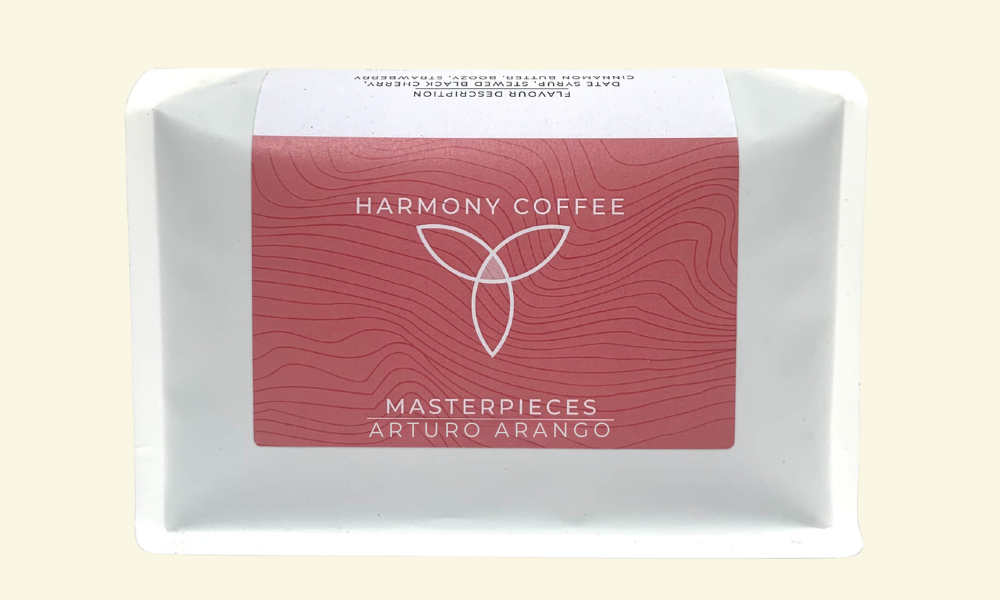
Harmony Coffee Roaster
ARTURO ARANGO
Couldn't load pickup availability
Arturo Arango – Colombia Natural Thermal Shock Sidra
Flavour Characteristics
Best As: Filter Coffee / Black espresso drinks / Milk Based Espresso Drinks
Flavour Description: Rosehip Syrup, Raspberry Jam, Passionfruit, Candied Green Apple
Origin & Producer Details
Producer: Arturo Arango
Farm: El Paraiso
Origin: Colombia
Region: Quindio
Variety: Sidra
Process: Thermal Shock Natural
Suitable For & Recommended Rest
SUITABLE FOR: ESPRESSO & FILTER BREW METHODS
BEST AS: ESPRESSO (Black & Milk based) & FILTER (Black)
Recommended rest: For the best tasting results, we recommend brewing this coffee 24–40 days off roast.
About This Coffee
This extraordinary lot from Arturo Arango showcases the meticulousness and innovation that Colombian experimental processing has become globally renowned for.
Working from Finca El Paraíso in Quindío, Arturo has dedicated his career to understanding how cultivation, fermentation, and processing can be refined to express coffee at its highest potential. Like many producers in Colombia’s modern specialty movement, his work is driven by precision, careful cherry selection, tightly controlled fermentations, and a willingness to experiment with techniques that push beyond conventional processing.
Despite being quite a new producer (only since 2015), Arturo has become very quickly known for his meticulous approach to coffee cultivation, constantly refining his methods to achieve the highest quality output possible. He is part of a new generation of coffee farmers combining existing, hard earned knowledge with pioneering development at the forefront of agricultural science.
This Sidra was cultivated at Finca El Paraiso in Barcelona, Quindio, one of Colombia's most celebrated coffee growing regions - known for its rich volcanic soils, high altitude climate and breathtaking landscapes. Year round stable temperatures result in slow maturation of the coffee cherries, producing coffees with pronounced sweetness, high clarity and vibrant acidity.
The region itself is located within the UNESCO world heritage site, as part of the coffee cultural landscape, yet has also become a world leading hub of innovation, with many producers taking on experimental processing and advanced fermentation techniques to broaden their repertoire, pushing the boundaries of coffee cultivation and output quality.
What is Sidra?
Sidra is a rare and highly sought after cultivar of the C. Arabica species. I'll be transparent... Sidra is one of my all time favourite coffee varieties, famed for its intense aromatics and complex yet elegant flavour profile.
There's actually a little bit of debate regarding Sidra's genetic lineage, but the broader consensus these days is that Sidra delineates from Ecuadorean grown Ethiopian landraces that have acclimatised to the local terroir and demands of the region.
Certainly the classic Sidra flavour profile gives a nod to its Ethiopian heritage, with intense florality, bright acidity, silky texture and (in naturals) tropical and berry fruit sweetness, making it exceptionally expressive.
I always get very excited when I have the opportunity to roast a new Sidra, and this one is just about as good as they can get!
If you want to learn more about the Sidra coffee variety, click here.
To learn more about other coffee varieties, you can check out our Coffee Varieties page.
What is a Thermal Shock Process?
Thermal shock processing is an advanced fermentation approach that combines a carefully managed anaerobic fermentation (usually in sealed barrels) with a rapid temperature change to slow down or alter microbial/enxzymatic activity.
Fermentation needs a little bit of energy to get going, but after which is an exothermic process, meaning that it generates heat as microorganisms consume the sugar in the system, but additionally to this, fermentations accelerate when there is more heat in the system, reaching their maximum intensity when the fermentation hits around 30-35c.
I like to equate fermentation in coffee to a vehicle accelerating towards the edge of a flavour cliff, where your goal as the producer is to maximise the quality of your fermentation, and safely bringing it to a halt before you drive your fermentation off of the cliff and ruin your product, by creating flavour related defects such as vinegar and phenol.
In this analogy, a thermal shock process is like equipping your vehicle with a set of brakes, letting you take your fermentation right to its maximum flavour potential before pulling the brakes and halting the fermentation in its tracks.
The way this is done in a thermal shock is by fermenting the coffee cherries in an anaerobic environment, closely monitoring the temperature, Brix, PH and many other metrics. Once the coffee has reached its desired level of fermentation, the producer takes the cherries and plunges them into very cold (often ozonated) water, dramatically slowing the progression of the fermentation.
How to Brew This Coffee
Because this coffee is expressive and fruit-forward, accurate dose and yield help you hit the sweet spot. We strongly recommend using a reliable scale — see our guide, The Best Coffee Scales, and our bench favourite, the Felicita Parallel.
Brewing tips
- Rest window: Follow the recommended 24–40 days off roast for best clarity, flavour intensity and balance.
- Filter brewing: Start with a 1:16–1:17 ratio and a medium-fine grind, adjusting to balance florals and fruit intensity.
- Espresso: We have enjoyed this coffee best at between 1:2 - 1:2.2, brewed in about 30 seconds, where we achieve lots of Jam-like characteristics and a syrupy body.
- Best recipe: Orea v4, 16g coffee, 250g water, 2:30 brew time. I'm using a higher dose than usual on this coffee because it gives up its soluble material very easily, so we can get heaps of body out of this brew.
Explore More Recipes
To try out more recipes from world-class coffee brewers, we've compiled this blog, featuring the best filter coffee recipes of 2026 from some of the world's best filter coffee brewers.
Frequently Asked Questions
What does this Colombian coffee taste like?
This coffee is super high sweetness as a result of the variety and processing. Expect a lot of berry-like sweetness and jammy characteristics, alongside rose florals.
Is this coffee better for espresso or filter?
It performs beautifully as both. This coffee is a true all-rounder.
Where is El Paraiso located?
El Paraiso is located in Quindio region of Colombia, near the small town of Barcelona.
What is Sidra coffee?
Sidra is a variety of C. Arabica, famed for its quality potential and high flavour clarity.
How long should I rest this coffee after roasting?
We recommend resting this coffee for 24–40 days after roasting to allow flavours to fully develop and stabilise.
Is this coffee ethically sourced?
We source this coffee via Cofinet, who import these coffees into the UK. They work repeatedly with the same farmers, frequently servicing under-appreciated/under-represented farmers who have low market access.
Explore other coffees
-
Agua Fria - A gorgeous naturally processed Brazilian coffee, cultivated by Paulo Agualetti in Divinolandia, with flavours of Macadamia and Hobnobs.
- El Vergel Decaf - Quite possibly the best decaf coffee we've ever found. It's called 'Really good decaf' for a reason. World class flavour, without the buzz.
- Kibaya — Rwanda washed Red Bourbon. A very high-clarity washed lot with citrusy and black tea characteristics.
- Luis Anibal - An incredibly complex natural Java from the wizard of Huila himself, Luis Anibal Calderon!
- Browse our single-origin coffees
Love this coffee?
Get coffees like this delivered on repeat with our Single Origin Subscription.
Check out some of our guides