Quick answer and contentsHow much does a cup of coffee cost a café?
About 49p–66p in coffee and milk, from a 4oz to a 12oz cup, using £24 per kilo of coffee, an 18g dose and £1.85 for 4 pints of milk.
Work out your cost per cup
Example figures are filled in. Swap in your own prices and it updates as you type.
Change
Every cup size, and how it's worked out
| Cup | Coffee | Milk | Total |
|---|
A worked example
| Cup | Coffee | Milk | Total |
|---|---|---|---|
| 4oz | 43p | 6p | 49p |
| 6oz | 43p | 10p | 53p |
| 8oz | 43p | 14p | 57p |
| 10oz | 43p | 19p | 62p |
| 12oz | 43p | 23p | 66p |
£24 per kilo, an 18g dose and £1.85 for 4 pints. The coffee is the same 43p in every cup, so the gap between sizes is almost all milk. Cups, lids, staff, rent and VAT come on top.
Free downloads
Take the calculator with you. Free to use, change and share.
How it's worked out
- The shotAn 18g dose pulled at 1 : 2 gives about 36ml of espresso.
- The milkSteamed milk fills the rest of the cup.
- ExpansionMilk grows about 20% when steamed, so you need less cold milk than the space in the cup.
- Wastage10% is added for milk left in the jug.
- The costGrams of coffee × price per gram, plus millilitres of milk × price per millilitre.
- Filter coffeeAbout 60g per litre (1 : 16.7), with a cold milk splash of 10% of the cup.
Open “Every cup size, and how it's worked out” in the calculator to see each step with your own numbers.
Guides and FAQs
GuideWays to lower your cost per cupQuick wins behind the bar, plus bigger long-term savings
- Match the jug to the drink, and mark a fill line for each cup size.
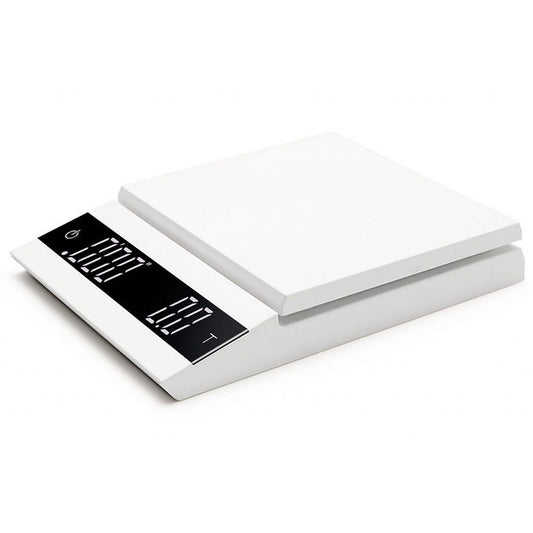
- Weigh every dose. Our guide to the best coffee scales can help.
- Dial in efficiently with a settled grinder and a clear recipe.
- Store coffee well. See how long to rest your coffee.
Bigger wins, long term
The biggest savings rarely come from cheaper beans or milk. They come from how consistently your team turns those ingredients into great drinks.
1. Invest heavily in training
Your team handles every gram of coffee and every drop of milk you buy, so training is one of the best-value investments you can make.
- Dialling in. Baristas who know your grinder can dial in with a couple of shots each morning.
- Steaming the right amount. When everyone knows how much milk each cup needs, far less is left in the jug.
- Splitting milk. One jug for two drinks, split cleanly, saves time and milk.
- Knowing your recipe. Clear dose, yield and time. A wasted shot costs around 50p, but a great drink brings a customer back.
- Trusting your team. Give baristas the skills and freedom to re-dial when shots start running fast.
2. Clean and maintain your kit weekly
A weekly deep clean (backflushing, soaking baskets and portafilters, brushing out the grinder) keeps everything performing.
- More consistency. Shots stay on recipe from open to close.
- Better flavour. No old, bitter coffee oils.
- Fewer surprises. Regular care keeps your machine running on busy days.
3. Consider a grind-by-weight grinder
Grind-by-time doses drift through the day, which often means over-dosing.
- Every gram counts. 1g extra per drink adds 2.4p at £24 a kilo. Across 200 drinks a day, that's roughly £1,750 a year.
- A simpler workflow. The dose looks after itself, so baristas only manage grind size.
4. Look at an automated milk system
Systems such as the Marco Milk Pal or Uber Milk can transform a busy milk station.
- Faster service. More milk drinks per hour at your busiest times.
- The exact amount, every time. No leftover jug, which can save hundreds of pounds a month.
5. Check your cup sizes
A 10oz latte and a 5–6oz flat white keep the coffee at the heart of the drink and make a great standard.
- Match takeaway cups to sit-in cups. The most common thing we see is a bigger cup to take away than to drink in.
- A better drink and a better margin. A 16oz latte filled to the top costs about 13p more than a 10oz. Across 100 takeaway lattes a day, that's nearly £13 a day.
FAQHow much does a cup of coffee cost a café to make?
In our worked example (£24 for 1kg of coffee, an 18g dose and £1.85 for 4 pints of milk), coffee and milk come to roughly 49p–66p per drink from 4oz to 12oz. Cups, lids, labour, rent and VAT come on top.
FAQHow many coffees can you make from 1kg of beans?
At an 18g dose, about 55 espresso-based drinks. At 20g, about 50.
FAQWhat ratio should espresso be pulled at?
Many cafés pull espresso at around 1 : 2, so 18g gives about 36g. Some coffees taste best a little shorter or longer, so the calculator lets you change it.
FAQHow much does milk expand when it's steamed?
Silky milk for lattes and flat whites grows by around 20%. Foamier cappuccino milk grows more.
FAQHow can a café reduce milk waste?
Use a jug sized for each drink, mark fill lines for each cup size, and steam only what the order needs.
Roasted in York, with free local delivery across York, Leeds and Harrogate.

Ben, Head of Coffee at Harmony Coffee. Competition barista and trainer with over a decade in specialty coffee.