Quick answerHow do I make my own coffee water?
Make the mineral bottles once. Then weigh a little from each bottle into distilled water. The calculator gives you the exact recipe in grams.
How to make it
Two steps: make the mineral bottles once, then mix your water each time.
Tap to see why a step matters.

You need
- Distilled waterDistilled water is clean and has 0 ppm minerals. You control exactly what goes in, so every batch comes out the same.
- 5 food-grade mineral saltslisted in Step 1
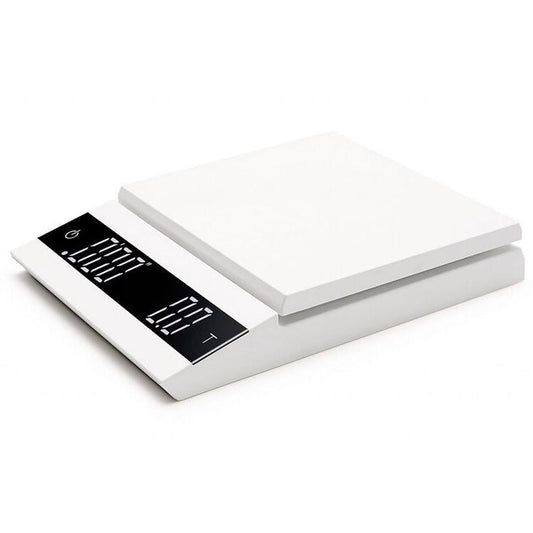
- A scale accurate to 0.01 gYou only weigh about 2 g of salt. A normal kitchen scale isn't accurate enough.
- 5 pristinely clean 1 litre bottlesPlastic marked 2 or 5 is best. Avoid metal, because the minerals can corrode it.
Step 1Make the mineral bottles
Do this once. Each bottle is one salt plus distilled water, 1000 g in total.
- Epsom saltMagnesium (MgSO4·7H2O)2.46 g+ 997.54 g waterMagnesium pulls flavour out of the coffee. Get food grade, not bath salts. The pack should say heptahydrate.
- Bicarbonate of sodaBuffer (NaHCO3)1.68 g+ 998.32 g waterThe buffer softens sharp, sour flavours. Not baking powder.
- Calcium chlorideCalcium (CaCl2·2H2O)1.47 g+ 998.53 g waterCalcium adds a rounder, fuller taste. Calcium chloride comes in two types. Buy the dihydrate (CaCl2·2H2O), not anhydrous. If you only have anhydrous, use 1.11 g with 998.89 g water instead.
- Potassium bicarbonateBuffer (KHCO3)2.00 g+ 998.00 g waterA second buffer with no sodium. Mixing it with bicarbonate of soda keeps sodium low, close to the SCA guide.
- Magnesium chlorideMagnesium (MgCl2·6H2O)2.03 g+ 997.97 g waterA second source of magnesium. Filter recipes use a little for a rounder cup. Espresso recipes skip it, because chloride is harder on machines. The pack should say hexahydrate.
- Weigh the distilled water into a clean bottleSalt and water together make 1000 g. That's what makes 1 g in 1 litre of finished water add exactly 1 ppm.
- Weigh the salt separately, in a small cupWeighing the salt on its own means you know the amount is exact, and every grain goes into the water.
- Tip the salt into the water and shake until dissolvedAlways add the salt to the water, not water to the salt. Salt tipped into a full bottle dissolves quickly and fully. Water poured onto a pile of salt can leave clumps stuck to the bottom, and the bottle comes out weaker. Tap the cup so every grain goes in.
- Label it and store it sealed in a cool, dark cupboardKeep it out of sunlight and away from heat. The fridge is fine too. Magnesium and calcium bottles keep 3 months, buffer bottles 1 month.
- Never mix the calcium and buffer bottlesTogether they turn into chalk, like the scale in a kettle.
Step 2Make your water
Do this each time. The calculator below gives you the weights.
- Weigh the distilled water into a jugAlways add the bottles to the water, not the other way round. The calcium and buffer bottles are strong. If they meet before they're diluted, they can turn into chalk (scale) that won't dissolve again, and your water comes out weaker than the recipe. A full jug dilutes every drop straight away, so this can't happen.
- Weigh in the buffer bottles first, and stirBuffer and calcium are the pair that make scale. Stirring the buffer in first means it's already spread thin when the calcium goes in.
- Weigh in the magnesium and calcium bottles, and stir
- Store it sealed in the fridge and use within 2 weeksCold slows anything growing in the water. Room temperature is fine if you use it within a few days.
Coffee Brew Water Calculator
Pick your coffee. It shows how much of each bottle to add. It's a starting point, so taste and adjust.
Suggested starter recipe
For your machine manual
Weigh the water into a jug, then weigh in each bottle, buffers first. Taste, then adjust.
Why this recipe?
What's in this water recipe? mg per litre
Est. pH is for water that has sat open to the air. pH has no unit.
Your water is sorted. Now pick a coffee roasted for filter.
Shop our filter coffeesFree spreadsheet
Plan your batches in Google Sheets. Enter batch size, hardness and alkalinity, and live formulas work out every dose and mineral.
Tips
Tips, tricks and best practicesTasting, espresso machines, storage
Taste and adjust
- Too sour? Add a little more buffer.
- Flat or dull? Use a little less buffer.
- Weak or not sweet? Add a little more magnesium and calcium.
- Harsh or bitter? Use a little less magnesium and calcium.
- Change one thing at a time.
- Never use zero buffer.With no buffer at all, coffee can taste sharp and vinegary.
Espresso machines
- Keep some calcium, but not too much.Calcium adds body to the cup, but it's also what makes scale. Our 70/30 magnesium and calcium mix gives you both. Descale as your machine maker advises.
- Check your warranty. Some machines need their own water.
- Never use plain distilled water.Many machines need minerals in the water to sense the water level.
- Run some water through first thing.Water that sat hot overnight can taste different.
Storage
- Magnesium and calcium bottles: 3 months.
- Buffer bottles: 1 month.The buffer slowly reacts with air. Keep the lid tight.
- Keep salt packs sealed.Damp salt holds less mineral, so your water comes out weaker.
- Throw away anything cloudy or smelly.
- Label the bottles and keep them away from children.
The science
The science, brieflyWhat each mineral does, units and standards
What the minerals do. Brewed coffee is about 98% water. Hardness (magnesium and calcium) helps pull flavour out of the coffee. Alkalinity, the buffer (mostly bicarbonate), neutralises acids, which softens how sour the coffee tastes.[1,2]
Magnesium and calcium. Lab modelling found magnesium binds more strongly than calcium to many coffee flavour compounds. That may be why magnesium-rich water tastes brighter and more intense.[2] It's modelling, not a taste test, so treat it as a direction. Calcium adds body, but it's also the main cause of scale.[1]
The buffer is the biggest lever. Of everything in your water, bicarbonate usually changes the taste most. Too much makes coffee flat and chalky. Too little and it can taste sharp and vinegary. Most of the difference you taste comes from the balance between hardness and buffer.[1,4]
Why espresso gets its own recipe. An espresso holds about as much acid as a filter cup made from the same dose, but in a fraction of the water. So espresso usually wants a little more buffer, and less hardness to keep scale down.[1,5]
Why scale forms. When water is heated, calcium and bicarbonate combine into calcium carbonate, the chalky scale in kettles. Espresso boilers stay hot all day, so they scale faster. Magnesium is less prone to scale than calcium, which is one reason our recipes lean on magnesium.[1]
Sodium and potassium. A little sodium is fine, but too much can taste salty or flat. The SCA suggests about 10 mg/l.[3] Our recipes take part of the buffer from bicarbonate of soda and the rest from potassium bicarbonate, so sodium stays low.
Sulfate and chloride. These come along with the magnesium and calcium. Many brewers find chloride gives a rounder, sweeter cup and sulfate a crisper, drier one. That comes mostly from tasting rather than lab work. Chloride can also corrode metal at higher levels, so our espresso recipes keep it low.[3]
How the bottles work. Each bottle is made so that 1 g of it in 1 litre of finished water adds 1 ppm. That lets you weigh grams instead of tiny fractions of a gram of dry salt.
Units. ppm and mg/l mean the same thing in water. Hardness and alkalinity are given “as CaCO3”, which puts magnesium, calcium and bicarbonate on one scale so they can be added together. Machine manuals call them GH and KH and often use German degrees (°dH). 1 °dH is about 17.8 ppm, and the calculator shows both.[1]
Why distilled water. Tap and bottled water change by area, season and batch. Starting from 0 ppm and adding known amounts is the only way to make the same water every time.[1]
TDS meters. A meter measures how well water conducts electricity, then turns that into an estimate. Each mineral reads differently, so two waters with the same TDS can taste very different.[1,3]
The SCA water standard. The Specialty Coffee Association publishes target ranges for brewing water.[3]
| Measure | Target | Range |
|---|---|---|
| Hardness (as CaCO3) | 68 mg/l | 17–85 mg/l |
| Alkalinity (as CaCO3) | 40 mg/l | Near 40 mg/l |
| TDS | 150 mg/l | 75–250 mg/l |
| Sodium | 10 mg/l | Near 10 mg/l |
| pH | 7.0 | 6.5–7.5 |
pH. The calculator estimates pH from the alkalinity. With this much buffer, water left open to the air settles at about pH 7.5–8.1, a little above the SCA range. Tap water often reads lower because it holds extra dissolved carbon dioxide. The buffer, not the pH number, is what shapes the cup.
Our recipes use 35–70 ppm hardness. Alkalinity runs 22–42 ppm for espresso and up to 40 ppm for filter, with less buffer for delicate and experimental coffees.
Extra reading
- Water for Coffee 2, Maxwell Colonna-Dashwood and Christopher H. HendonThe book this guide leans on most. Clear chemistry, written for baristas.
- The role of dissolved cations in coffee extraction (2014)The study behind the magnesium and calcium findings.
- SCA Water Quality HandbookThe industry standard for brewing water.
- Water for extraction, in The Craft and Science of Coffee (2017)A readable overview of water composition and treatment.
- Water quality for espresso coffee (2010)How water changes espresso and the machines that make it.
- Brew Water CheckOur free tool for seeing what's in your tap water.
Glossary
Hardness
Magnesium and calcium. They pull flavour out of coffee.
Buffer (alkalinity)
Softens sour flavours. Too much makes coffee flat.
ppm
Parts per million. The same as mg per litre.
Distilled water
Clean water with 0 ppm minerals, so you control exactly what goes in.
Scale
The white, chalky crust in kettles and machines.
TDS
A rough total of everything in the water.
SCA
The Specialty Coffee Association. It sets standards for brewing water.
FAQs
Can I use tap water?
You can use tap water as a base. The catch is that tap water changes through the year, even on the same supply. With distilled water, you always know exactly what's in it. The recipes here are built for distilled water, because tap water already has minerals in it. Our Brew Water Check shows what's in your tap.
Can I put everything in one bottle?
No. Calcium and buffer turn into chalk when they're together. Keep the buffer in its own bottle.
Can I use bottled water?
Most bottled water has too much buffer for coffee, so it tastes flat. Some brands do sell low-mineral water. But if you're buying bottled water anyway, it's better to filter the water you already have another way and skip the plastic.
Why doesn't my TDS meter match?
Meters only guess, and each mineral reads differently. Use one to compare batches, not to make them.
Can I add minerals after brewing?
Yes, this can work. We see it a bit like a whetstone: use it to round out a cup, not as your main way of adding minerals. The science is still new. One reasonable idea is that the added minerals push some dissolved coffee compounds out of the liquid as aroma, which changes how the cup smells and tastes.
Is bicarbonate of soda the same as baking powder?
No. Use bicarbonate of soda. Baking powder has other things in it.
A new single origin from our farm partners, delivered weekly, fortnightly or monthly. Great for filter and espresso.
Explore subscriptions
Ben, Head of Coffee at Harmony Coffee. Competition barista and trainer with over a decade in specialty coffee.
Suggestions only. Recipes are starting points. Use food-grade ingredients, label your bottles, and check your espresso machine maker's water advice. Harmony Coffee accepts no liability for decisions based on these suggestions (October 2026).
Based on
- Colonna-Dashwood M, Hendon CH. Water for Coffee 2. Revised edition of Water for Coffee (2015).
- Hendon CH, Colonna-Dashwood L, Colonna-Dashwood M. The role of dissolved cations in coffee extraction. Journal of Agricultural and Food Chemistry. 2014;62(21):4947–4950. doi:10.1021/jf501687c
- Specialty Coffee Association. SCA Water Quality Handbook (SCA Water Standard). 2018. sca.coffee/research/coffee-standards
- Wellinger M, Smrke S, Yeretzian C. Water for extraction: composition, recommendations, and treatment. In: Folmer B, ed. The Craft and Science of Coffee. Academic Press; 2017:381–398. doi:10.1016/B978-0-12-803520-7.00016-0
- Navarini L, Rivetti D. Water quality for Espresso coffee. Food Chemistry. 2010;122(2):424–428. doi:10.1016/j.foodchem.2010.02.039